For two decades, one federal judge held authority over more territory than many nations — and his court's record remains one of the most documented in American legal history.
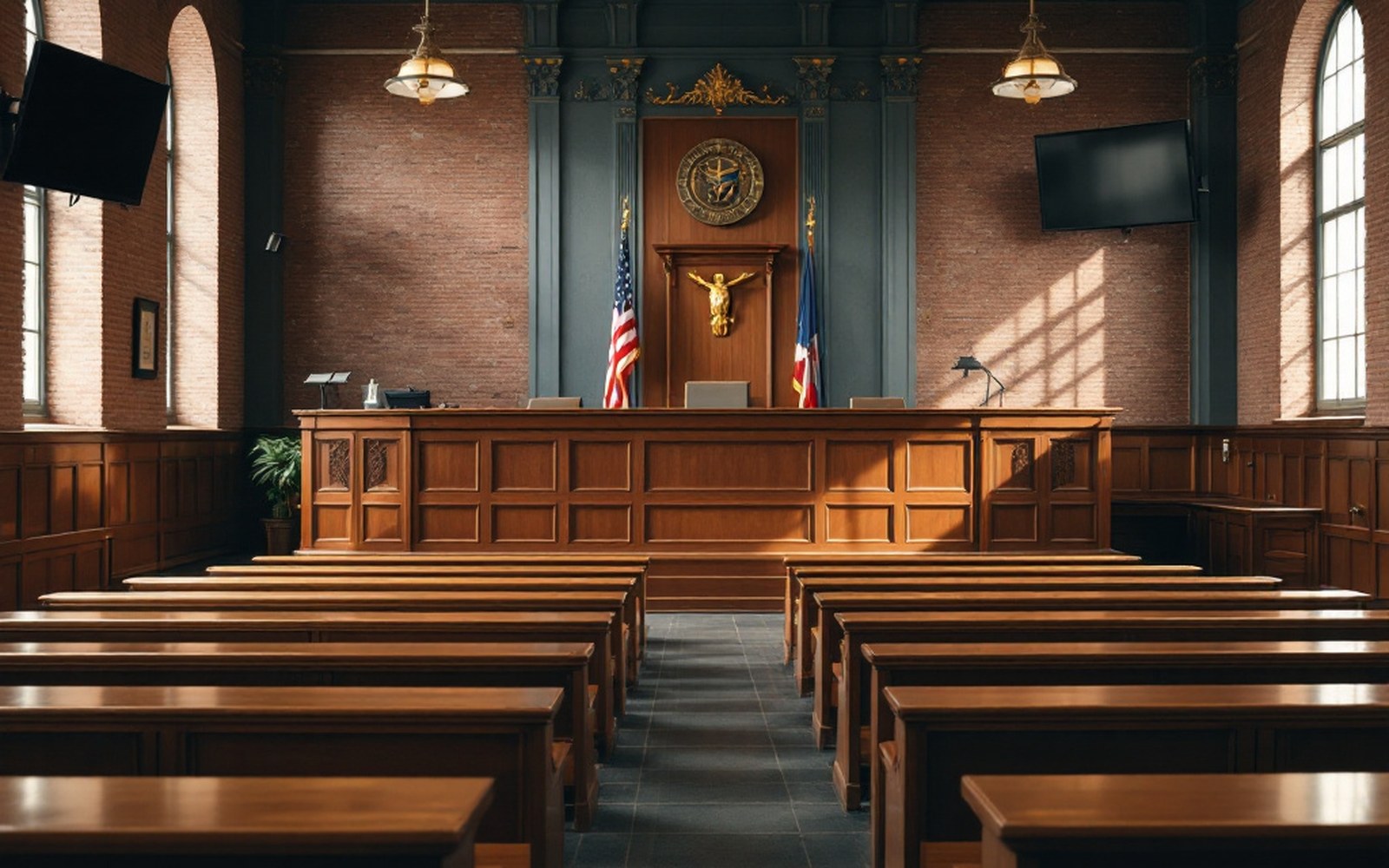
He presided for twenty-one years over a court whose reach was unlike any other in the federal system.Photograph · Sebastian County Online
The Appointment and What It Meant
Isaac Charles Parker arrived in Fort Smith in May 1875 at the age of thirty-six, appointed by President Ulysses S. Grant to preside over the United States District Court for the Western District of Arkansas. The position had been vacant and the court had fallen into disorder; Fort Smith itself was a rough river town at the edge of a jurisdiction that extended westward across Indian Territory — the legally distinct lands of the Cherokee, Choctaw, Chickasaw, Muscogee, and Seminole nations — for a reach of roughly seventy-four thousand square miles. No other federal district court in the country governed anything close to that expanse.
Parker was not a frontier figure by origin. He had been a circuit judge in Missouri and a U.S. congressman before his appointment, and he came to Fort Smith as a trained jurist with a clear sense of what the court was supposed to do. What it was supposed to do, under the jurisdictional framework then in force, was supply federal criminal law to a territory where the Five Nations maintained their own governments and courts but where the United States had reserved authority over crimes involving non-citizens of those nations, and over major crimes generally. The arrangement was a legal and political imposition on nations that had their own constitutions, legislatures, and judicial systems — and Parker's court operated at the center of that imposed structure for the entirety of his tenure.
The court's reach was not merely geographic. In 1875, Congress gave the Western District exclusive original jurisdiction over Indian Territory, stripping an overlapping court in Kansas of its share. That consolidation meant that every federal criminal case arising in the Territory came to Fort Smith — to the same courtroom, the same docket, the same judge. The volume was immediate and large.
See Aniyvwiya.Photograph · Sebastian County Online
The Court in Operation
Parker held his first session in May 1875 and within weeks was presiding over a docket that included murder cases. By the end of that first term, he had sentenced eight men to death, of whom six were hanged on a single day in September 1875. That event was widely reported at the time and established a national impression of the court that followed Parker for the rest of his life and beyond it — an impression he found reductive and, in later years, openly contested.
The mechanics of the court required a large apparatus of enforcement. Deputy U.S. marshals rode into the Territory to serve process, arrest defendants, and return them to Fort Smith — sometimes across hundreds of miles of difficult country. The deputy marshal force was notably diverse: among its members was Bass Reeves, the first Black deputy U.S. marshal west of the Mississippi, who served under Parker's court for decades and compiled an arrest record that remains extraordinary by any measure. The marshals worked on a fee system, received no salary, and bore their own expenses in advance — a structural arrangement that shaped who took the work and how it was done.
The courthouse itself stood on the grounds of a former military garrison at the edge of the Arkansas River. Parker's courtroom occupied the upper floor of the old barracks building; the basement served as a federal jail. The physical arrangement — courtroom above, cells below — was not metaphorical but it was legible, and the courthouse at Fort Smith carried that dual character throughout the Parker years. Conditions in the jail were consistently poor and were noted in contemporary accounts and official correspondence.
Parker ran long sessions. The court operated through multiple terms each year, and Parker was known to work without interruption through cases that stretched across days. He charged juries with care, and the written records of his charges survive in sufficient quantity that legal historians have used them to reconstruct his judicial thinking in some detail. He believed in the rehabilitative intent of law but showed little hesitation about capital sentences where he judged the facts warranted them. Over twenty-one years, his court tried a documented number of capital cases and handed down sentences that place it, by the numbers, among the most active capital courts in federal history.
Jurisdiction Contested and Curtailed
The court's authority did not remain static. Through the 1880s and into the 1890s, Congress progressively altered the jurisdictional structure that had made Parker's court singular. In 1889, defendants in Indian Territory capital cases were granted the right to appeal to the Supreme Court — a right that had been explicitly withheld under the original statute, meaning that Parker's death sentences had until then been final with no avenue of review beyond a presidential pardon. The grant of appeal rights introduced a new layer of legal process and reversed a number of convictions. Parker's relationship with the Supreme Court grew openly adversarial in his later years; he was recorded in interviews as criticizing specific reversals by name, and the court's reporters noted the friction plainly.
In 1889 and again in 1890, Congress further divided the Territory's jurisdiction among newly created federal courts within the Territory itself. By 1895, when Congress established the U.S. Court for Indian Territory, the Western District's reach had been substantially curtailed. Parker by then was ill. He continued on the bench, though his health deteriorated visibly through 1896. He died in November of that year, still in office, at fifty-eight.
What the Record Shows
Parker's twenty-one-year tenure produced a court record that is voluminous, reasonably well preserved, and held in part at the National Archives and through the National Park Service, which administers the Fort Smith National Historic Site. The case files, docket books, and marshal records constitute a primary source for the legal and social history of Indian Territory during the period — including documentation of crimes, defendants, victims, and enforcement conditions that would otherwise be largely invisible.
The historical literature on Parker is large and uneven. The "hanging judge" label, which attached to him in newspaper coverage during his lifetime and never fully detached, reflects a real statistic — his court did sentence more people to death than almost any other federal court — but it papers over the jurisdictional complexity that produced those numbers. The Territory was vast, underpolicied by any federal standard, and the court was the only federal mechanism in reach. Whether that mechanism was appropriate to the nations whose lands it operated over is a different and harder question, one the nations themselves answered clearly: the Five Nations had functioning governments and courts and had not requested the extension of federal jurisdiction. What Parker administered was the law as Congress had structured it, over lands to which that structure was applied by treaty and political force rather than by the consent of those governed by it.
His reputation endures because the jurisdiction over Indian Territory that his court exercised was genuinely unlike anything else in the federal system — not a temporary arrangement or an administrative anomaly, but a sustained legal apparatus that shaped the Territory's development, its population's relationship to federal power, and ultimately the conditions under which Oklahoma statehood was constructed. Parker was its most visible instrument, and the record he left is indispensable to understanding what that apparatus actually did.
A nation with its own courts, districts and written law — whose territory also happened to sit atop one of the more valuable coalfields in the mid-continent. See Chahta.Photograph · Sebastian County Online
The southernmost of the Five Tribes held its own legislature, courts and governor — and sits largely outside the frame when the view begins at Fort Smith. See Chikasha.Photograph · Sebastian County Online